
A Practical Guide to Change Management for Nonprofits



Lauren Fulthorpe
When a nonprofit moves to a new CRM or makes changes to other technology or processes, it isn’t just a technical upgrade. It’s a fundamental shift that requires careful change management.
To navigate it successfully, it’s important to be thoughtful in the transition approach and recognize that successful change happens in two inseparable dimensions:
- The Foundation (The Macro): This is the infrastructure that supports the change. It includes things like technical system, strategic vision, and organizational readiness.
- The People (The Micro): The personal transition, the learning curve, and the emotional response of the individuals who bring the mission to life.
If you roll out new software without properly training the staff, you have a powerful system that’s not used correctly or not used at all as people default to their old workflows. Similarly, if you inspire the staff but give them no structure, you have passion without a platform. Change is best managed when you both build The Foundation and support The People.
The Foundation
Before a single person can change their habits, the organization must provide the structural integrity for that change to exist. In the world of change management, we can turn to the Prosci Change Triangle (PCT)™ to ensure the structure is sound.
This means balancing three areas:
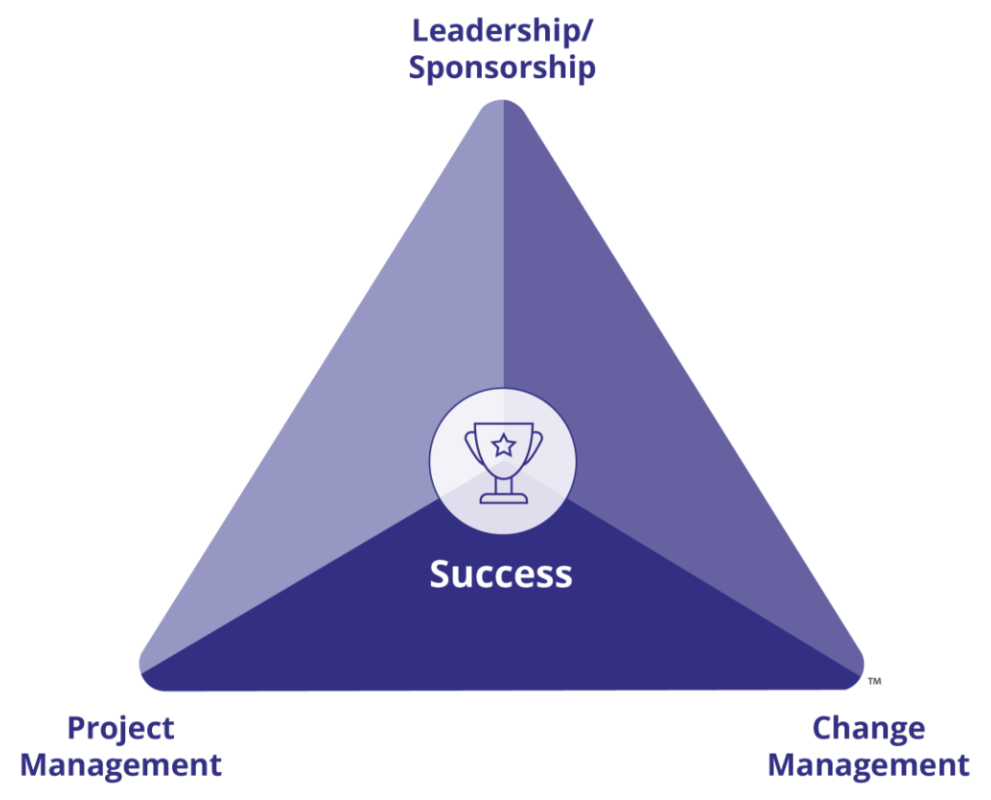
- Leadership/Sponsorship: Is leadership clear on how this project will move the needle for stakeholders?
- Project Management: Do we have the right platform and a realistic timeline?
- Change Management: Is there a structured approach to transition the staff?
The Importance of Leadership Support
With any change of this nature, the Executive Director, President, or Board cannot simply approve the budget and walk away. They must be active and visible. When leadership is seen championing the vision and the project, the rest of the organization views the shift as mission-critical rather than a temporary venture.
The People
The organization provides the structure, but it’s individual staff members who make change happen. You can’t expect change to be successful if you haven’t set up the right conditions for them to learn and adapt.
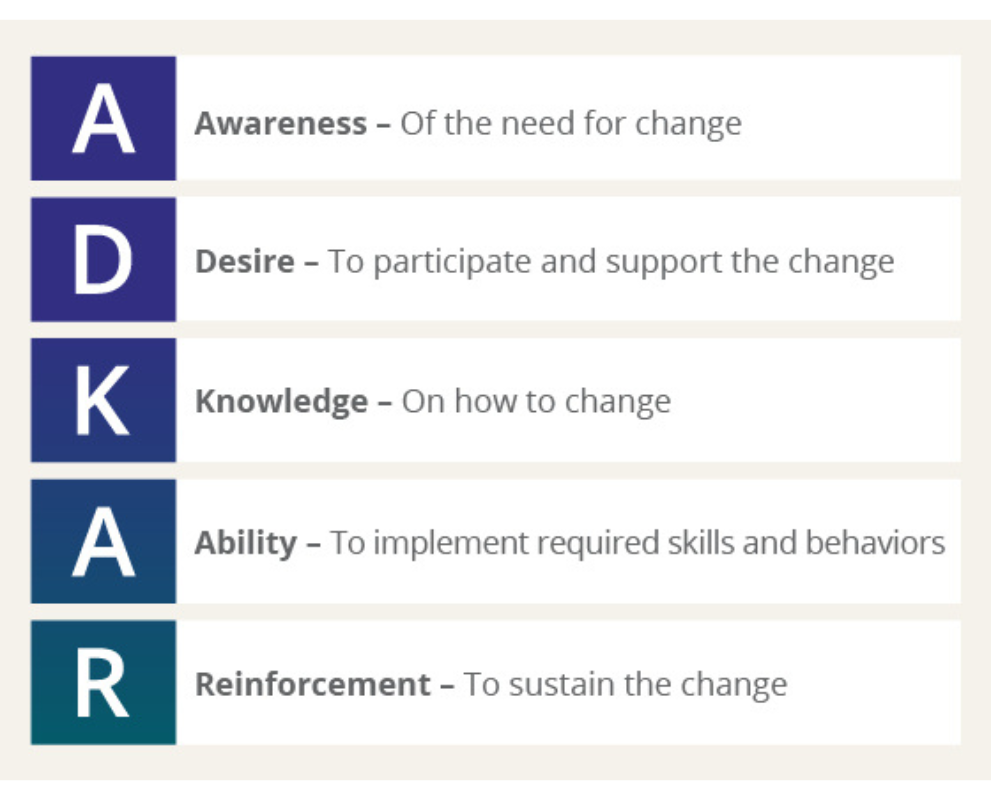
Using Prosci’s ADKAR model (Awareness, Desire, Knowledge, Ability, and Reinforcement), we can guide individuals through their own personal journey of change.
ADKAR at Work
Here are some examples of what this might look like in practice:
- Maria the Medical Records Coordinator: Maria trusts paper charts more than digital systems. She lacks the Desire to change because she fears HIPAA violations and data breaches.
The Strategy: Involve her in the data security review process. Show her how the new system provides better audit trails and compliance safeguards than paper records ever could.
- Dr. Chen the Department Chair: Dr. Chen loves teaching but is chronically short on time. He lacks the Ability to master a complex administrative tool.
The Strategy: Provide micro-learning opportunities (10-minute training bursts) and safe sandboxes of the new environment where he can experiment, make mistakes without affecting live data, and provide feedback on ways the system can continue to improve.
- David the Development Officer: David keeps his donor notes private to maintain control. He lacks the Awareness of the collective benefit.
The Strategy: Show David how shared constituent data can help him identify major gift prospects he never knew existed, including grateful patients or successful alumni.
Change management is not a one-size-fits-all installation. Success lies in the nuances. In the examples above, we looked beyond departmental labels to see the individuals, and our strategy involved meeting them with the specific tactics that resonated with their fears and motivations.
When you personalize support, you don’t just implement a system or launch a project; you ensure that every member of the team is set up for a successful transition.
The Installation
Once the “Why” is established and the individual needs are understood, you need a practical installation strategy.
Peer-to-peer learning
Staff are often more receptive to learning from a colleague who speaks their departmental language. This is where a change champion can be your biggest asset. These are early adopters from different departments who are respected by their peers and act as the bridge between the new system and daily workflows. For example, a change champion in the Education department can be equipped with knowledge to help translate technical CRM steps into educator-speak.
Workflow mapping
Don’t just teach the software; teach the role. Reviewing the ADKAR framework, we see that Knowledge leads to Ability. It is important to show a fundraiser exactly where the new system removes a manual headache from their day. This knowledge gained will positively influence their use of the new solution, building their ability.
Data as a shared resource
Use the transition to break down departmental silos. Show your teams that a patient record isn’t just for one department, but is a shared history that helps staff work together to cultivate meaningful relationships.
Making Change Stick
The most dangerous phase of any transition can be the six-month slump, when initial excitement fades and staff revert to old habits. Here are some tips to making change stick.
- Give it time: Learning is real work. Leadership must provide the structural space for staff to master new tools, even if it means temporarily adjusting other KPIs.
- Highlight data wins: If a staff member spends hours organizing constituent records, show them the insight that helped the organization make a better decision or secure new funding. When people see their data in action, the system moves from a burden to a benefit.
- Have a clear sunset date: To prevent system ghosting, set a clear date when old, redundant processes are officially retired. This provides the clarity the team needs to fully commit to the new architecture.
- Schedule a review: Treat your digital systems like a rotating gallery, not a stone monument. Schedule a review six months after launch. Ask: Is the system still serving the staff? What new workflows have emerged? This ensures the system evolves as your institution grows.
Checklist for Organizational Change
☐ Define the Success Value
- Can you explain the “Why” in two sentences without using technical jargon?
- Does the staff understand how this specific change directly supports the organization’s mission (not just the bottom line)?
- Have you communicated that data is a shared organizational asset and not just owned by one department?
☐ Secure Executive Sponsorship
- Is the Executive Director, President, or Board prepared to be an Executive Sponsor, visibly using the new tools and talking about the data in meetings?
- Is there a dedicated budget not just for the software, but for the time and training required to learn it?
☐ Assess Individual Readiness
- Have you assessed your team? Do you have strategies and tactics in place to ensure they are heard, supported, and understood?
☐ Appoint Change Champions
- Have you identified respected early adopters in each department to act as local experts?
- Is there a clear feedback loop for staff to report issues as they arise?
☐ Plan for Permanent Change
- Have you planned a way to celebrate the Go-Live milestone? It’s been a big endeavor – mark the occasion!
- Have you set a closing date for legacy systems to prevent double-entry and system ghosting?
- Do you have a plan to celebrate Data Wins within the first 90 days to prove the system’s value?
- Is there a scheduled review in six months to refine the system based on staff feedback?
Need Support?
Change management for nonprofits requires both technical expertise and an understanding of how mission-driven organizations work. You don’t have to do it alone.
Our Prosci® Certified Change Management Practitioner is ready to support your journey, addressing both the technical requirements and the human reality of change.
Let’s Talk!