
Trends in Performing Arts Audience Behavior: 4 Key Takeaways for 2026



Jonathan Carpenter
Program Manager, Performing Arts
Earlier this month, we released our latest study on Trends in Audience Behavior. In the study, we analyzed over 12 million tickets representing over $1 billion in revenue from performing arts organizations around the country to understand how the start of the 2025-26 season compares to the previous three seasons.
The data surfaced reminders that revenue growth requires us to be intentional about our programming and our prices. Whether you’re encountering these points for the first time or you’re being reminded of these crucial considerations, we encourage you to think about these four points carefully as you wrap up the 2025-26 season and start to plan for 2026-27.
#1: Your performance calendar is a key factor in your ticket sales.
Both tickets sold and income were down in the fall of 2025 compared to the previous two fall seasons. Our data suggests a few potential reasons for this decline, but there is one primary consideration that drove these decreases: the total number of performances offered also dropped this fall. With fewer performances on the calendar, organizations had less inventory to sell, which limited their ability to reach the same number of tickets sold or the same amount of revenue brought in from ticketing.
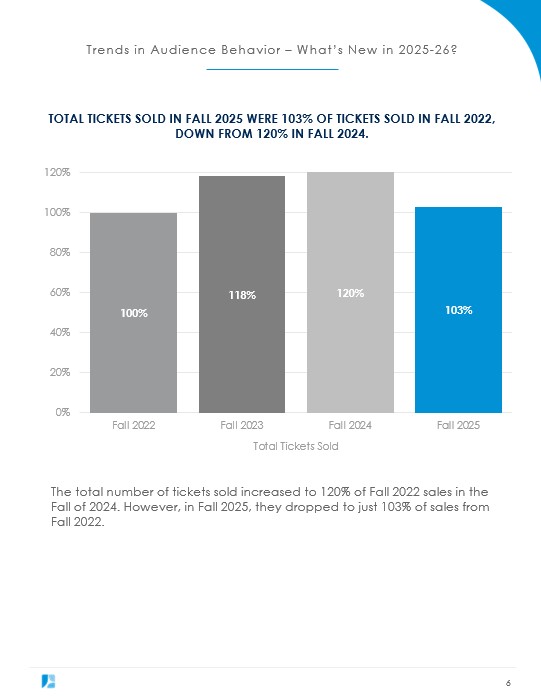
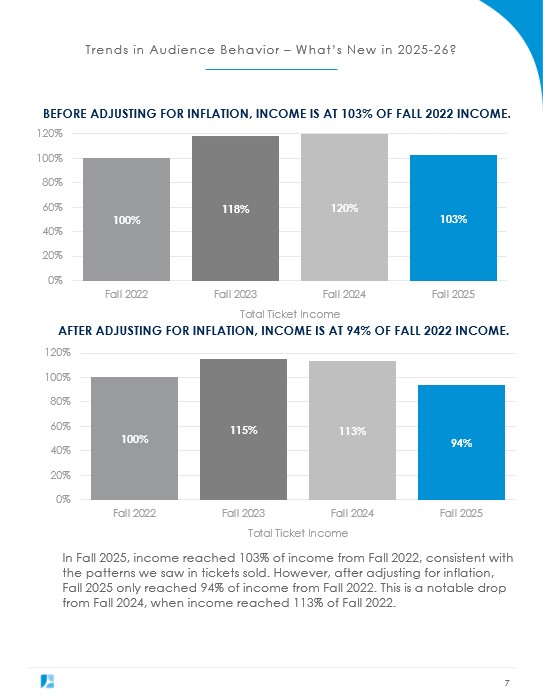
Your performance calendar is going to determine your revenue potential, and fewer performances means less potential revenue, whether the result of fewer productions overall or fewer performances within the run of each production. Dance companies, theatres, and performing arts centers all had significant drops in the number of performances offered in fall 2025, and they all saw corresponding drops in tickets sold and total ticket income. On the flip side, music organizations and opera companies had more total performances in the fall of 2025 and saw growth in tickets sold and ticket income.
Of course, season size is bound to fluctuate; it’s understandable that some seasons will have more performances than others. But we wanted to highlight the importance of considering season size when setting your revenue goals. If you set higher goals with fewer performances being offered, you will need to carefully consider how you will reach higher percentages of capacity sold at higher prices to meet those goals.
#2: Consider inflation when setting your ticket prices.
Economic anxiety is high, and we know that everyone is concerned about inflation and how much just about everything costs right now. Many performing arts organizations may feel an obligation as nonprofits to keep their ticket prices low. We see that in our data. Average ticket prices have lagged significantly behind inflation. In fact, we found that the average start price for tickets went down slightly in the fall of 2025, indicating that on average, organizations slightly lowered their starting prices.
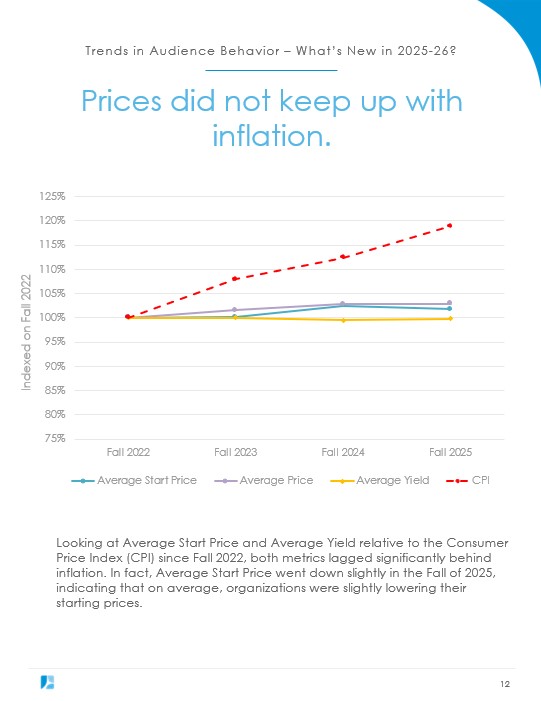
We encourage organizations to offer accessible ticket prices. We are strong proponents of radical pricing, an approach to pricing that puts extraordinary emphasis on making people feel welcome. However, we believe that radical pricing can exist within a larger context of smart differentiated pricing. While your organization may not be comfortable raising prices consistently with inflation, we encourage you to consider inflation when setting your prices. Once again, we see that it takes intentional consideration of ticket prices in order to achieve revenue growth; with lower average start prices, revenue growth becomes a significant challenge.
#3: Be intentional about discounts.
We saw an increase in discount tickets as a percentage of overall tickets this fall – from 16% of all tickets in fall 2024 to 18% of all tickets in fall 2025. When combined with an increase in subscription tickets as a percentage of overall tickets, this means that more audience members are coming through your doors with a ticket purchased below full price. This means that organizations must be intentional about their discounts, particularly against the backdrop of offering fewer performances and slightly lower starting prices.
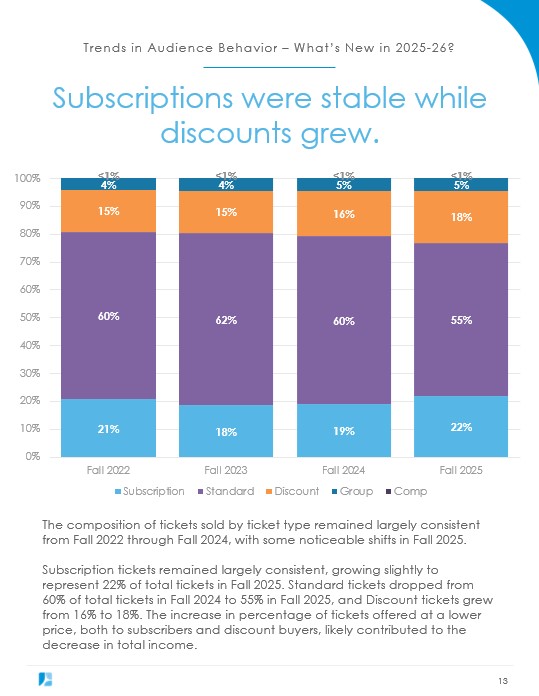
Certainly, you should encourage loyalty and offer a discount to your subscribers, but how deep is that discount? If your subscribers fill up a significant proportion of your capacity for a given performance, will you be in a situation where it has become impossible to meet your ticket sales goal for that performance?
With other discount tickets, consider whether you are using those discounts strategically and whether they are needed. An annual Black Friday discount might be a key strategic event that drives ticket sales for your performances in December and January. However, offering a fire sale on a performance that isn’t showing signs of price sensitivity might simply be cutting into your income – and dinging your audience’s value perception of your performances in the process.
It’s always important to use discounts as strategic tools, and that is doubly true now, as we see that discounted tickets represent a greater percentage of all tickets sold.
#4: You can utilize dynamic pricing to continuously refine and optimize your prices.
Incremental income is growing as a percentage of total income. In the fall of 2022, it represented 4.6% of total income, and in the fall of 2025, it represented 6.2% of total income. Organizations are recognizing more opportunities to adjust their prices every year.
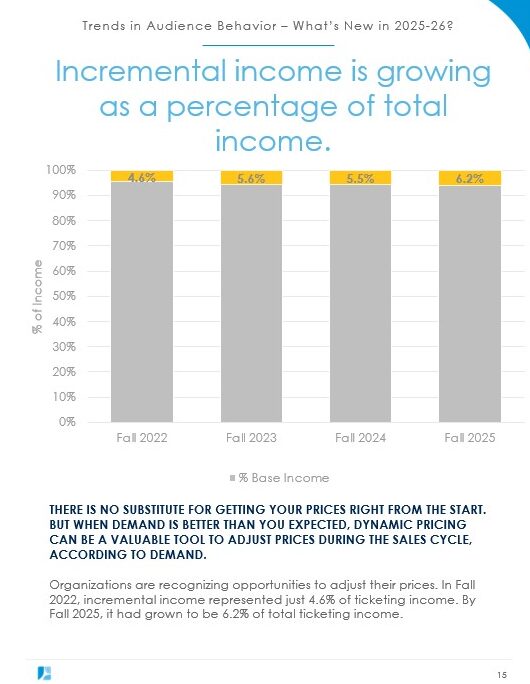
There is no substitute for getting your prices right from the start. But when demand is better than you expected, dynamic pricing can be a valuable tool to adjust prices during the sales cycle, according to demand.
And you don’t have to wait until you’re close to selling out. You can use early indicators of demand to help you maximize your revenue from your most popular performances.
We found that the organizations in our study made an average of $360,578 in additional income from dynamic pricing this fall. That’s an extra $360K made without selling a single additional ticket! If your organization isn’t yet utilizing dynamic pricing, now is the time to start, particularly given the other challenges we’ve identified in achieving year-over-year revenue growth.
What’s next?
We hope, as always, that our latest study provides helpful points to consider and a useful benchmark for tracking your own organization’s progress. You can download the complete study here.
Wondering where to go from here? Looking for a place to start with dynamic pricing? Want to optimize your subscription offerings to ensure consistent yearly loyalty while not hindering overall revenue growth? We’re here to help.
JCA Performing Arts is here to help you turn your data into actionable insights that fuel strategy and drive success. Let’s talk about how we can help you do that.
Start a Conversation